Joseph Ku’s Book Intro
永樂大典介紹 古偉業
最近承蒙灣區學者嵇義達博士慨然捐贈北京中華書局多年前印行的『永樂大典』複印本共十冊。使華光中文閲覧室圖書館增色不少。
『永樂大典』是明成祖永樂年間(1403AD) 邀請學者編撰的一部囊括所有中國古籍詞語解說的百科全書,迄今已經有620年的歷史。英文百科編目按字母,永樂大典則以《洪武正韻》作為目,以韻統字,用字繫事,先是韻目編排韻字,並對應的內容編纂在對應的韻字之下。如天文志都會載於「天」之下,地理志都會載於「地」字之下;收錄內容以「上自古初,下及近代經史子集」作為分針,對天文、地理、人倫、國統、道德、政治、制度、名物以至奇聞異事、庾詞、逸事都會收錄。
永樂大典原本已經失散,現有散居世界各地的斷簡殘篇多是嘉靖年間抄本(1562年)。抄本有50公分高,30公分寬,比現在通用B size 紙張大一點。文以正楷抄寫,朱墨兩色。內中也有手繪圖示。現在中華書局發行的影印本縮小很多,但是仍然可以閱讀。這裡展示抄本的圖片及影印本的照片。對於中國古籍有興趣的人士,歡迎來本館參閱。
Introduction to “Yong Le Da Dian” Joseph Ku
Recently, Dr. Francis Kai, a scholar from the Bay Area, donated a total of 10 Volumes of the “Yong Le Da Dian” published by Beijing Zhonghua Book Company many years ago. It really enhances the book collection of HuaKuang Chinese Room library. The “Yong Le Da Dian” is an encyclopedia compiled by scholars during the “Yong Le” reign of Emperor Chengzu of the Ming Dynasty (1403 AD), which has a history of 620 years.
The English encyclopedia is cataloged by letters, and the “Yong Le Da Dian” took “Hongwu Zhengyun” phonics sequence as their index, used rhyme to unify words, and uses words to connect the things being described, first arranging rhyme words, and the corresponding content is compiled under the corresponding rhyme words. For example, astronomical chronicles will be included under the word “heaven’, and geography will be included under the word “earth”, and the content of the collection will be “subset of ancient classics and histories” as the main part, and the astronomy, geography, human ethics, national unity, morality, politics, systems, famous objects, as well as anecdotes will be included. The original books of “Yong Le Da Dian” was lost during war in dynasty changing, and most of the fragments scattered around the world were manuscripts from the Jiajing period (1562 AD). Those manuscript size is 50 centimeters high and 30 centimeters wide, a little more than the current B-size paper. The text is copied in block letters with the black and red inks two colors. There are also hand-drawn icons inside.
The photocopies distributed by Chung Hwa Book Company are now much smaller, but they can still be read. Pictures of the manuscript and photographs of photocopies are shown here. For those who are interested in ancient Chinese books, please visit our library.
posted 9/23/2024
四庫全書
“四庫全書”是由清朝乾隆皇帝三十八年 (1772) 開始編修,歷時十一年直至乾隆四十六年 (1783) 完成。“四庫全書”是中國最大的叢書,而且是保全最好的古書。乾隆皇帝在這十一年間曾多次下詔命令各省官員收集官方及民間各種書籍,並不惜重金搜購私人藏書,然後動員四千多人主管纂修,校對,協勘,繕寫,鑑定,製造等職位。
“四庫全書”分為四部,即是 「經」,「史」,「子」,「集」。「經」是經書,包括詩經,禮記,春秋,易經,孝經等,都是綜合儒家各種研究相關著作。「史」是包括史書,傳記,地理,制度,軍政等科目。「子」是包括兵法,醫卜,天文術數,藝術,器物,草木蟲獸,食物等項目。「集」是包括詩,詞,曲,文等作品。“四庫全書”原版有79337 卷,約9.97億字。但是乾隆皇帝本人曾經禁毀很多野史筆記,加上後來歷代的改易,重編,現存的版本已經面目全非。
“四庫全書”一共製作了七套,其中四套被毀於太平天國及八國聯軍之亂。剩下三套一套現藏台北國立故宮博物院,一套藏於蘭州甘肅省圖書館,一套在北京中國國家圖書館。
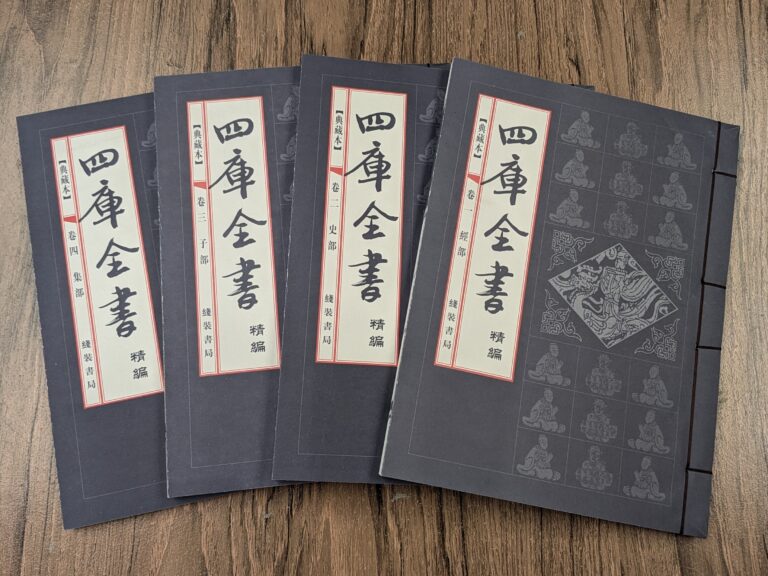
華光擁有的是“四庫全書精編”。即是編者選出「經」,「史」,「子」,「集」裏最具代表性的文章而編成。“四庫全書精編”沒有編號,讀者要閱讀請向當值的義工詢問。
SiKuQuanShu
The “SiKuQuanShu” was compiled in the thirty-eighth year of Emperor Qianlong of the Qing Dynasty (1772) and lasted eleven years until it was completed in the forty-sixth year of Qianlong’s reign (1783). “SiKuQuanShu” is the largest book series in China and the best-preserved ancient book. During these eleven years, Emperor Qianlong issued many edicts and ordered provincial officials to collect various official and private books, and spent large amounts of money to purchase private collections. He then mobilized more than 4,000 officials to take charge of compilation, proofreading, collation, rewriting, appraisal, and production.
“SiKuQuanShu” is divided into four parts, namely “Jing”, “Shi”, “Zi” and “Ji”. “Jing” refers to classics, including Shi Jing, Li Ji, Chun Qiu, Yi Jing, and the Xiao Jing etc., which are all comprehensive works related to various studies on Confucianism. “Shi” includes history books, biographies, geography, institutions, military affairs and other subjects. “Zi” includes items such as military art, medical divination, astronomy, art, utensils, vegetation, insects, animals, and food. “Ji” includes poems, lyrics, music, articles and other works. The original version of “SiKuQuanShu” has 79,337 volumes and about 997 million words. However, Emperor Qianlong himself banned many unofficial history notes and inappropriate works, and with subsequent changes and re-editing in the following dynasties, the existing version has been completely changed.
A total of seven sets of “SiKuQuanShu” were produced, four of which were destroyed by the Taiping Rebellion and the Eight-Power Allied Forces invaision of Beijing. Of the remaining three sets one is in the National Palace Museum in Taipei, one is in the Gansu Provincial Library in Lanzhou, and the third is in the National Library of China in Beijing.
What HuaKuang owns is the “Essence of SikuQuanShu”. That is to say, the editors selected the most representative articles from “Jing”, “Shi”, “Zi”, and “Ji”. “Essence of SikuQuanShu” does not have a catalog code. Readers who want to read it should ask the volunteers on duty.